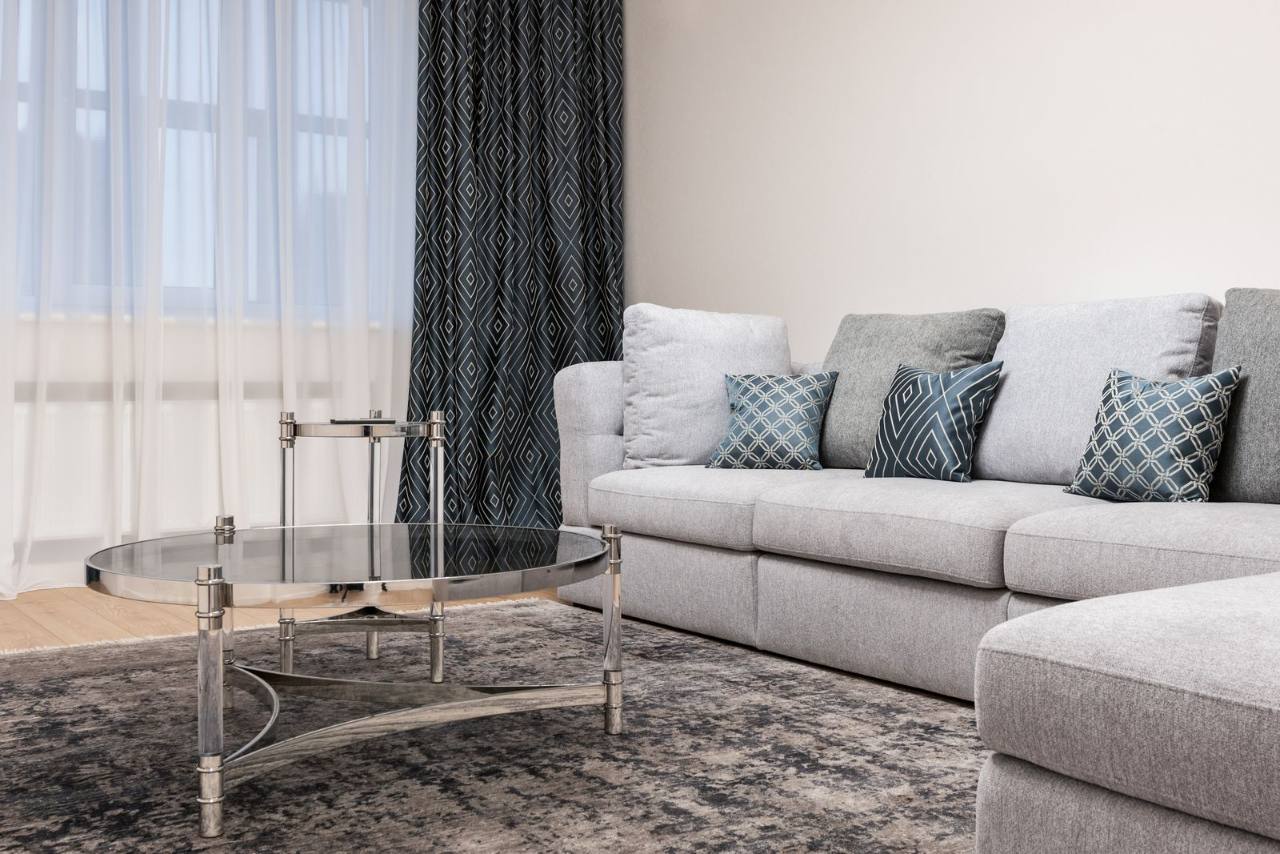
The right rug size for a small living room is usually a 5×8 or a 6×9: big enough that the front legs of your sofa and chairs sit on it, small enough to leave 8–12 inches of bare floor along the walls. If your rug only fits under the coffee table and the furniture floats around it, it’s almost certainly too small, and that one mistake makes a compact room look even smaller.
Below you’ll find a quick size chart, the placement rules interior pros use, what to do with a sectional, and how to get a high-end look whether you’re buying a budget flatweave or a hand-knotted wool rug.
Key takeaways
- 5×8 or 6×9 fits most small living rooms; a 4×6 usually looks lost.
- Aim for at least the front legs of the sofa and chairs on the rug.
- Leave 8–12 inches of floor around the edges in a small room (12–18 inches in a larger one).
- With a sectional, a 6×9 works for a small sofa-and-chaise; an L-shape often looks better on a square or round rug.
- Measure with painter’s tape before you buy. It’s free and it prevents the most common mistake.
Rug size for a small living room: quick chart
Use this as a starting point, then check it against your actual furniture layout. Rug sizes are given in feet (standard US sizes).
| Room / layout | Best rug size | Placement |
|---|---|---|
| Very small room or studio seating nook (about 9×10 ft) | 5×8 | Front legs of the sofa on the rug, or a “coffee table only” float |
| Small living room (about 10×12 ft) | 5×8 or 6×9 | Front legs of the sofa and chairs on the rug |
| Small-to-medium room (about 11×14 ft) | 6×9 or 8×10 | Front legs on; 8×10 if you have two chairs opposite the sofa |
| Small sofa with chaise | 6×9 | Rug runs along the chaise, 6–12 in past its front edge |
| Small L-shaped sectional | 7×7 or 8×8 square, or 7–8 ft round | Tucked into the corner of the “L” |
| Long, narrow living room | 5×8 or 6×9 per zone, or a 5–6 ft round | One rug per seating zone |
Most retailers sell the same standard sizes: 3×5, 4×6, 5×8, 6×9, 8×10, 9×12 and 10×14, plus runners and rounds from about 4 to 8 feet. In practice, small living rooms almost always land on a 5×8 or a 6×9. Outside the US, the nearest common metric sizes are 160×230 cm (close to a 5×8) and 200×290 cm (slightly larger than a 6×9).
How to measure before you buy (the painter’s tape trick)
This takes ten minutes and saves you a return.
- Set your furniture first. The rug is sized to the seating group, not the room.
- Measure the seating group. Measure from the front legs of the sofa to the front legs of the chair opposite, and across the width of the sofa.
- Add 6–12 inches beyond the sofa’s width on each side if the room allows, so the rug looks anchored rather than tucked.
- Tape the outline on the floor at the nearest standard size (try both 5×8 and 6×9 if you’re torn).
- Live with it for a day. Walk around it, open doors and check the border to the walls. Whichever outline feels calmer is your size.
9 rules for sizing a rug in a small living room
1. Get the front legs on the rug
The most forgiving layout for a small room is “front legs on”: the front two legs of the sofa and each chair rest on the rug, while the back legs sit on the floor. It connects the furniture into one conversation area without needing a huge rug.
Whatever you choose, be consistent. If the sofa’s front legs are on, the chairs’ front legs should be on too.
2. Leave a smaller border than you would in a big room
The usual guideline, which rug experts quoted by Homes & Gardens call the golden rule, is 12–18 inches of bare floor between the rug and the walls. In a small room, 8–12 inches is fine and often looks better, because it lets you use a slightly larger rug.
Don’t overcorrect, though: Ruggable’s Claire Fitzpatrick advises sizing down in small rooms rather than forcing in a rug that crowds the walls. In a very narrow room, a slimmer border on the long sides is fine, as long as it looks even.
Going wall-to-wall with a rug reads as carpet, so keep at least a thin frame of floor visible.
3. Don’t let the rug float under the coffee table
A small rug sitting only under the coffee table, with every piece of furniture around it, is one of the most common living room mistakes. It chops the floor into islands and makes the room feel smaller.
The “coffee table only” layout can work in a tiny space, but only if the rug comes close to the furniture on all sides, with roughly the same gap all around.
4. Skip the 4×6 (most of the time)
A 4×6 is great for an entry, beside a bed or under a reading chair. In a living room it rarely reaches the sofa, so it ends up looking like a bath mat. If budget is the issue, look at a 5×8 flatweave or jute rug, which are often among the more affordable options at that size.
5. Run the rug the same direction as the sofa
Place a rectangular rug with its long side parallel to the sofa. This keeps the seating group feeling balanced and usually gives you a more even border to the walls.
6. Keep walkways clear
Your main path through the room should be either fully on the rug or fully off it. A rug edge that cuts across a walkway is a tripping point and makes the room feel cramped. If a door swings over the rug, check that it clears the pile.
7. Use a round rug to soften tight corners
Round rugs are a smart fix for small or awkward rooms. A 5–6 ft round works well under a round coffee table, in a reading corner, or inside the curve of a curved sofa (an L-shaped sectional usually needs a larger 7–8 ft round). The rounded edge breaks up all the straight lines and leaves more visible floor.
8. Choose a low pile and a rug pad
In a small room, furniture legs often sit right on the rug’s edge, so a thin rug can buckle or curl. A low-pile or flatweave rug on a pad that’s slightly smaller than the rug stays flat and keeps the edges from becoming a trip hazard. If your sofa still slides, these fixes for furniture sliding on hardwood floors help.
9. Pick color and pattern to stretch the space
Size does most of the work, but color helps. A rug close in tone to your floor blurs the edge and makes the room read larger, while a high-contrast rug draws a clear zone. A soft, all-over pattern hides wear better than a solid in a busy family room. For more space-stretching ideas, see our guide on how to make a room look bigger.
What size rug for a small living room with a sectional?
Sectionals take up more floor, so the rug has to work with their shape. These are the sizes Wayfair’s sectional rug guide suggests for smaller rooms, with how to place each one:
- Sofa with chaise: a 6×9 in a small room. Line the long edge up with the chaise and let the rug run 6–12 inches past its front.
- Small L-shaped sectional: a 7×7 or 8×8 square, or a 7–8 ft round, tucked into the inside corner of the “L” with the front legs on.
- U-shaped sectional: needs at least a 9×12, which is usually too big for a truly small room. If that’s your layout, consider swapping one arm for a chair.
With a sectional, never have the back of the rug end partway under the seat cushions. Either the front legs sit on the rug or the rug starts just in front of the sofa.
Small living room layouts and the rug that fits each
Sofa facing a TV wall
A 5×8 placed with the sofa’s front legs on it and the far edge stopping short of the TV console. If the room is wide enough for a side chair, a 6×9 lets that chair join the group.
Sofa plus two chairs
A 6×9 is usually the minimum, and an 8×10 if the border to the walls still works. Every piece should have its front legs on.
Long, narrow living room
Don’t stretch one rug down the whole room. Split it into zones, for example a 5×8 under the main seating and a round rug under a reading chair or desk. Our guide to arranging furniture in a long narrow living room shows layouts that pair well with this.
Studio or open-plan space
Here the rug’s job is to say “this is the living room.” Pick the size that just captures the sofa and coffee table, and keep it clear of the kitchen and entry paths. More ideas are in our post on decorating a small space without clutter.
Rug sizes for other rooms (quick reference)
Once your living room is sorted, the same logic applies elsewhere: size the rug to the furniture, then check the border.
| Room | Typical size | Rule of thumb |
|---|---|---|
| Bedroom, queen bed | 8×10 | About 2 ft of rug showing at the sides and foot |
| Bedroom, king bed | 9×12 | Same as above; place it under the lower two-thirds of the bed |
| Bedroom, full or twin | 6×9 | Or two runners, one on each side |
| Dining, 4 seats | 8×10, or a 6–7 ft round for a small round table | At least 24 in past the table on all sides so chairs stay on when pulled out |
| Dining, 6 seats | 8×10 | Same 24 in rule |
| Hallway | 2×6 to 2.5×10 runner | Leave a few inches of floor showing on each side |
Getting the luxury look on any budget
Budget-friendly: a flatweave cotton or jute rug in the right size will always look better than an expensive rug that’s too small. Machine-washable rugs are a good choice for renters, kids and pets. To make an inexpensive rug feel richer, layer a smaller vintage-style or faux-hide rug on top of a large neutral jute base.
Premium: hand-knotted or hand-tufted wool adds depth, softness and longevity, and wool is naturally resilient underfoot. In a small room, one quality rug in the correct size does more for the space than any accessory. If you’re investing, ask whether custom sizing is available so you get the exact border you want.
Whatever you buy, care matters. If an older or vintage rug smells stale, here’s how to get rid of a musty smell in a rug.
Common rug size mistakes in small rooms
- Too small: furniture floats around a tiny rug and the room looks chopped up.
- Half on, half off: the sofa’s back legs on and front legs off, or one chair on and another off.
- Too big: a rug that runs into the walls or under the TV console reads as carpet and hides your floor.
- Off-center: the rug should be centered on the seating group, not on the room.
- No pad: the rug slides, curls at the corners and wears faster.
FAQ
What is the best rug size for a small living room?
A 5×8 or 6×9 suits most small living rooms. Choose the one that lets the front legs of your sofa and chairs rest on the rug while leaving about 8–12 inches of floor around the edges.
Is a 4×6 rug too small for a living room?
Usually, yes. A 4×6 rarely reaches the sofa, so it looks disconnected. It works better as an accent rug under a chair, by a door or layered over a larger rug.
Does a bigger rug make a small room look bigger?
Up to a point. A rug that ties the furniture together makes the room feel larger and calmer than a small floating one. But a rug that touches the walls reads as carpet, so keep a visible border of floor.
Should the rug go under the couch?
Ideally the front legs of the couch sit on the rug, a few inches in from its edge. You don’t need the whole couch on the rug in a small room, but you should avoid the rug stopping just short of the front legs.
Can I use a round rug in a small living room?
Yes. A 5–6 ft round rug is a good fit under a round coffee table or in a corner seating nook, and inside an L-shaped sectional you can size up to about 7–8 ft. A round rug softens a boxy room and shows more floor than a rectangle.
The bottom line
For a small living room, start with a 5×8 or 6×9, get the front legs on, leave a slim border of floor and tape it out before you buy. Get the size right and even a simple, affordable rug will make the whole room look more pulled together.